
Camino Leon To Santiago – 2027
Wildlime Pilgrimage
TUESDAY, 5 OCTOBER - THURSDAY, 21 OCTOBER 2027
The Camino De Santiago - 300km on the Way Of St James
→ Leon to Santiago
Itinerary
Meet the rest of the Wildlime crew in Leon to begin your camino journey.
A beautiful, lively city, combining stunning historical architecture with an irresistible energy. Its standout attraction is the cathedral, one of the most beautiful in Spain, but there’s so much more to see and do here and a great place to get into the Camino spirit.
Today it takes some time to clear the city limits of Leon so catching a bus to the outskirts of the city to avoid built-up areas and begin our day at the monument of La Virgen Del Camino, marking the end of the city.
When in Virgen Del Camino we take the alternative Camino through Villar de Mazarife and over a flat and manageable stage.
Upon arrival at Hospital De Orbigo we will cross the magnificent stone medieval bridge the town is famous for. It has nineteen arches with the Río Órbigo (river) flowing through only three. A bridge reserved for pedestrians only As a Templar Town it also has a 12th Century Church.
Departing from Hospital de Orbigo, the VIlladangos route is the original Camino de Santiago where you will enjoy this scenic route as it wanders through picturesque countryside – a delightful walk today!
Upon reaching Astorga, a pretty hilltop city perhaps visit its ‘pink’ cathedral, designed by Antoni Gaudí . Constructed in 1471, it also now houses a museum.
Then there is the fabulous Episcopal palace, a sight to behold. Also, the monumental city walls, are a testament to times gone by.
Astorga is well known for its famous chocolates and “Las Mantecadas (cupcakes) de Astorga.
Leaving behind Astorga you will be walking on pleasant paths across plains and with good views of the hills before you. This next section of the Camino de Santiago journeys through to Ponferrada and passes through the area known as La Maragateria and then enters the Bierzo region with its mines and bordering Galicia. The La Maragateria area has very few villages and we recommend you always carry enough food and water for emergencies.
Make sure you carry warm clothing even in the height of summer with you as you will be walking into high mountains. The path runs parallel to the road, after approximately 5km from Astorga you reach Murias de Rechivaldo.
The Camino continues through El Ganso, down a track and runs parallel to the road. Here it passes an old oak tree Known as El Roble del Peregrino where many a pilgrim have rested in the shade of its canopy. As you walk along the path towards Rabanal del Camino (1155m) you pass the remains of the Roman gold mines of La Fucarona.
As you leave Rabanal del Camino you will start to feel the incline which steepens as you head into the hills towards Foncebadon (the infamous deserted village which is no longer deserted). The incline is always walkable and there are plenty of switchbacks with great views back over the plains behind you.
This is one of the most rewarding days but most emotionally challenging as it climbs to ‘Mount Irago’.Stop at the Iron Cross on top of the mountain, one of the most special places on the French Way, where you can place a memento and visit the St James chapel before descending to the lush area of El Bierzo.
“O Lord may the stone which I bring to this holy place be a sign of pilgrimage to Santiago. When I reach my final judgment, tip the balance of my life in favour of my good deeds. I lay down this token which I carry from [starting point]. Please forgive my sins and help me carry my burdens in life. Amen”
Passing over a few more hilly sections you will reach your highest point at Collado de las Antenas (1515m), from here it is a steep downhill to Molinaseca (610m).
This stage is 32km and we can reduce it to 26km by catching a bus to the city of Ponferrada which can be clearly seen in the distance.
Once in the city of Ponferrada, continue past the castle of the Knights Templar, make sure you enjoy a quick coffee in the plaza to admire the hills you’ve just climbed.
After Ponferrada, the walk continues through gently rolling hills and vineyards before reaching the charming town of Villafranca del Bierzo which is nestled in the hills that mark the border into Galicia.
We have a pleasant walking day in front of us today with gentle paths in the countryside. We soon enter the Valcarce riverside forest, with superb chestnut trees, then onto Trabadelo, a good place to stop for a drink and rest.
You may hear a change in the language with locals speaking Galician, the language of Galicia and bordering regions.
We head towards the village of Pereje. Walk down the Calle Camino de Santiago until we reach the village of Herrerias.
The Camino from this point onwards climbs through the mountains starting gently but progressively getting steeper until you reach the atmospheric hilltop hamlet of O Cebreiro.
O Cebreiro is as special as it is small. Nestled, at 1,300 metres of altitude, between the mountain ranges of O Courel and Os Ancares, the village is home to traditional mountain dwellings of pre-Roman origin, called ‘pallozas’. These unique homes can only be found in this region of Galicia along with ‘Queixo do Cebreiro’ the local soft creamy cheese, made using traditional artisan techniques, without artificial additives.
Along with a well-deserved afternoon to rest we get time to savour this beautiful hilltop setting.
Today’s journey runs through the spectacular Sierra de Ancares, giving us one of the most spectacular panoramic views of the entire French Way in a completely rural environment.
The route continues ascending until it reaches the Alto de San Roque, where we will see an imposing statue of a pilgrim fighting against the wind. After reaching the Alto do Poio ( 1.335 m), we will descend continuously until our end of the stage, Triacastela – a small village that puts an end to our first fully Galician stage.
In this stage we will be walking along the Oribio valley, one of the most impressive landscapes of the French route, surrounded by the river and lush forests of chestnuts, poplars and oak trees.
Another half day walking, we end at the benedictine monastery of Samos, the oldest inhabited monastery in Spain, with its impressive cloisters and murals. It’s at a high-altitude level walk but no real steep climbs so is a relatively manageable and enjoyable walk for most pilgrims. You will pass through charming villages, forests and the busy suburb of Sarria with buses loading Pilgrims off on route to Santiago.
A beautiful place to relax and enjoy some solitude before we hit the craziness of the last 100km from Sarria.
Let’s enjoy a little rest this morning before we begin the lovely descent through ancient forests with mystical features and passing through charming villages, forests and the busy suburb of Sarria with buses loading Pilgrims off on route to Santiago.
We will aim to get into Sarria by 2.00pm to give you time to rest, do laundry and relax before the craziness of the last 100km.
The majority of this walk is on sheltered woodland pathways or quiet country roads and passes through many hamlets and small villages. The scenery along the way is wonderfully green and lush and very rural. The trail climbs and falls repeatedly as it passes tiny hamlets full of history.
In the final section is the high point of the day (660m) Pat Pina dos Corvos which has wonderful views over the reservoir and surrounding countryside.
The Portomarín in which you will stay tonight is not the Portomarín that pilgrims in the Middle Ages knew; the old village lies below the waters of the reservoir in the valley below the present-day village, built in 1960.The impressive fortified church of St. Nicholas, built by the monk-knights of the Order of St. John of Jerusalem in the 12th century, was disassembled stone by stone and moved up the hill to its present location, together with the balcony of the village’s town hall and the Romanesque façade of the Church of St. Peter. Shortly before reaching Portomarín today you will pass the final 100-kilometre mark on the Camino.
Today’s walk is uphill for 15km however the gradient is never too steep, and you gradually climb to a height of 720m at Sierra Ligonde.
The walk is now downhill to Ligonde and Eirexe and onto A Calzada. There is a detour here of 4km to the National Monument, Vilar de Donas where the Knights of Santiago are buried and is worthy of a visit if we have time.
A gentle climb now takes you through several small hamlets to Alto Rosario and there are good vantage points on a clear day and then down into Palas de Rei.
A big walking day, it is mostly on paths through quiet woodland, crossing over the main road to Arzua several times and guiding you through six river valleys to reach a high point of 515m at Coto. On route you will pass Melide, famous for Pulpo Gallego, octopus cooked Galician style and reputed to be the best in Spain.
Much of the path after Melide winds through woodlands of oak, pine and eucalypt, passing over several valleys though Boente, Castañeda and then Ribadiso from where you can see the Hospital San Anton, one of the oldest pilgrim hospitals in existence.
From Ribadiso follow the country road on a steep uphill climb and through the outer suburbs before entering Arzua. With a population of around 7000 is the last large town before you reach Santiago.
The majority of today’s walk is through wonderful pine and eucalyptus scented woodland – it smells like home!
The path is mostly level, passing through three shallow river valleys with a gradual climb up to Alto de Santa Irene at 404m.
The final section climbs steeply to a main road, into eucalyptus woodland. O Pedrouzo is a small but busy town with plenty of shops, restaurants and bars and the staging point for the last section of the Camino before entering Santiago de Compostela.
Today’s route will be a busy as pilgrims begin the last stage of their walk into Santiago. Lavacolla village is where pilgrims traditionally washed to purify themselves before entering Santiago and Lavacolla literally means to wash your tail.
At Monte Gozo, Mount of Joy, you will first sight the stunning Catedral de Santiago spires. This is where you can leave another pilgrims stone if you wish.
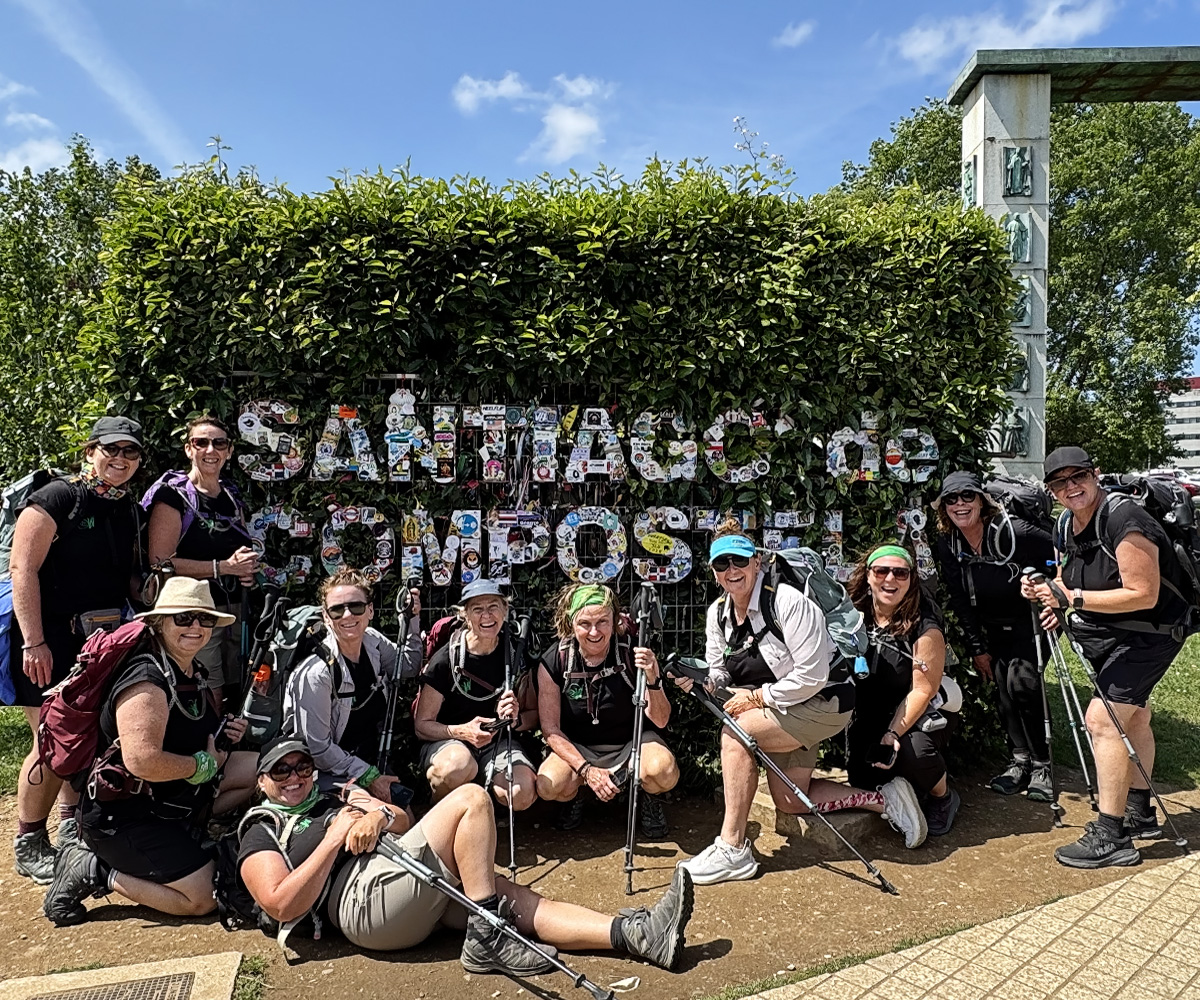
The walk into Santiago is emotional as you come to terms that you have walked over 700km from France to Spain – you are amazing !!
Before you depart try and go to the Pilgrim’s Mass in the cathedral at noon. Before Mass, if you wish to do so, head over to the Pilgrim’s Office to receive your Compostela. (please note there is on accommodation tonight)
“Don’t cry because it is over, smile because it happened” – Dr Seuss
$4795 Inclusive of:
- 16 nights twin share accommodation
- Daily breakfasts
- Welcome + Farewell dinners
- Daily luggage transfers
- Transfers between stages (as indicated)
- 1 private Camino preparation day
- Camino passport
- Camino Guidebook
- Taxes + gratuities
- Trekking + training notes
- Wildlime Tour leader
- Quarterly information zoom sessions to keep you on track and reaching your goals
- Take a walk on the Wildlime side t-shirt , luggage tag and hiking buff
- Private Wildlime Camino page to share information and ideas
- Wildlime tips + talks – a manual of all you need to know about walking, packing and preparing
- Wildlime guide with you every step of the way!
Not included:
- Flights ex Australia
- Transfers where indicated (these are a personal choice)
- Meals + drinks where not indicated
- Transfer to St Jean Pied De Port or alternate starting point
- Travel Insurance
- Personal expenses
- Camino training weekends
Conditions:
- $950 deposit is required to secure your place
- Deposit can be transferred but is non-refundable
- Program Is subject to change
Date
- Oct 05 - 21 2027
Time
- All Day